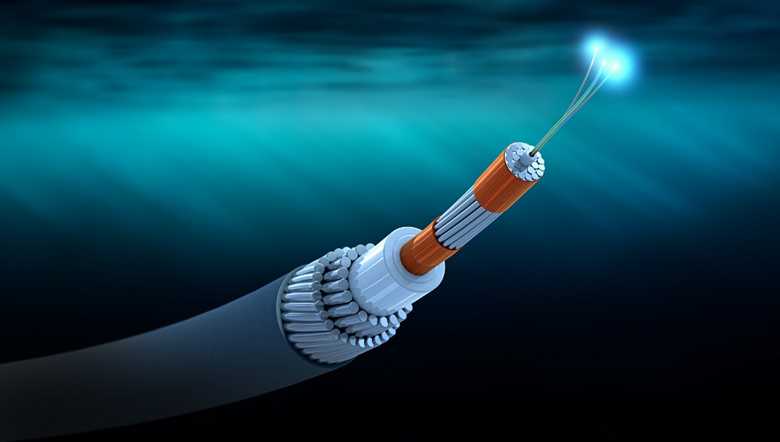

Did you know that 95% of global data traffic runs through the oceans? The majority of our daily communication runs through submarine cables. However, a video call is not routed through a specific cable to reach its destination; rather, it involves a branched infrastructure consisting of many different networks and servers.
Thus, data can traverse half the globe on its way from sender to recipient in milliseconds. We summarize the most interesting facts about the internet infrastructure for you.
We Humans Influence Deep-Sea Cables
The constant drive for new technological developments by humans influences the development of submarine cables. In 1851, the first submarine cable was laid between Dover and Cap Gris-Nez. This installation was essential and a great success for economic development. By laying the telegraph cable, a telephone connection between France and England was now established.
Through this innovation, a new goal was eventually achieved: Transatlantic submarine cables connecting Europe with America. In 1988, the first transatlantic fiber optic cable named TAT8 was laid between the USA, France, and Great Britain. Through the steady growth of the infrastructure, improved construction methods developed.
Installation of Deep-Sea Cables
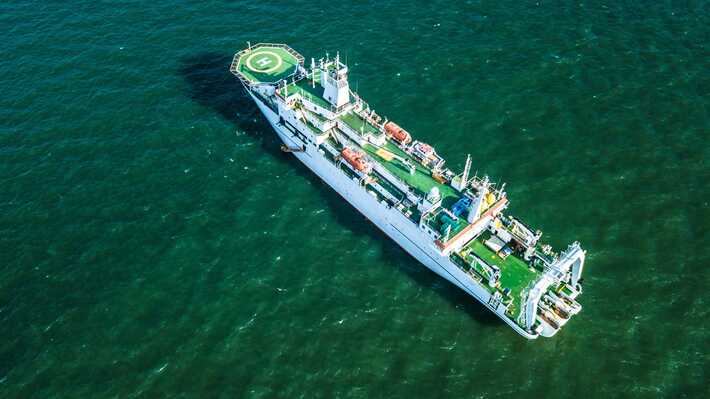
Using specialized vessels, the submarine cables are buried in the seabed. There are two different methods for this. These installation methods depend on the seabed. If it is sandy, the submarine cable is pressed into the ground, creating drifting sand into which the cables are buried. In the second variant, the seabed is opened using a submarine cable plow and the cable is laid in. The cables are brought ashore through a shaft at the beach.
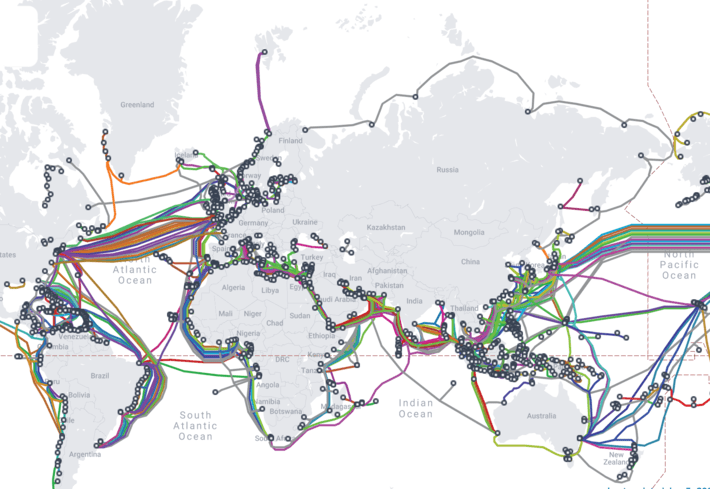
Global hubs include Marseille, New York, Singapore, and the United Arab Emirates.
Interactive Map of Deep-Sea Cables
Submarine Cables as New Attack Surfaces
Not only from a geopolitical perspective can submarine cables be interpreted as new attack surfaces. Currently, the USA and the People’s Republic of China are engaged in a competition in the construction of submarine cables. For alongside China’s largest foreign policy project, the construction of the new Silk Road, China also wants to participate in the expansion of submarine cables.
In Marseille, the People’s Republic of China is building the submarine cable “Peace”. The 12,000 km long cable is intended to connect China with Europe via the Horn of Africa and Pakistan.
Critics fear that China is building and financing the deep-sea cable in order to intercept the data of European citizens. This would not be a new phenomenon. In 2013, former CIA agent Edward Snowden revealed that the USA had been intercepting data from governments as well as from millions of people for years by tapping deep-sea cables.
Some time ago, Robert Martinage, a former Deputy Undersecretary of the US Navy and Pentagon official, criticized the fact that while many states prioritize cybersecurity, the physical infrastructure of the internet is less protected.
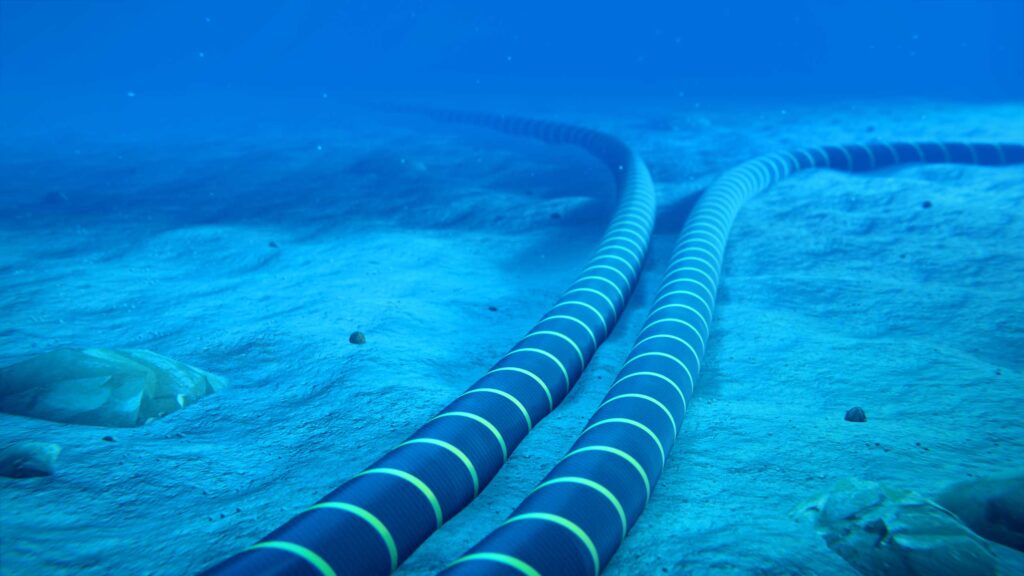
In addition to security risks, submarine cables can also be damaged by natural forces or fall victim to boat anchors and trawl nets. However, this does not directly result in an internet outage, as the data usually reaches its destination via other routes.
What Does the Future Hold?
Traditional telecommunications companies are no longer investing in the construction of submarine cables. They have been replaced by US companies such as Google, Microsoft, and Meta, which are increasingly participating in the market. Chinese companies such as Huawei are also becoming increasingly active in the construction of submarine cables. An increasing privatization of the provision of this infrastructure is evident, which also means an increasing dependence of Europe on the USA and China.
Data and the Climate
The fact that data is always available does not come without consequences. Data is a real environmental polluter. In 2019, French researchers found that data is responsible for a large portion of global CO2 emissions.
Streaming services such as Netflix and others are particularly criticized. However, it makes a significant difference which data center you use. With leitzcloud by vBoxx, your data is stored climate-neutrally in the German data center Maincubes in Frankfurt. This is a data center that uses 100% renewable energy and thus consumes 60-80% less CO2. Through the highest security standards, your data is excellently protected.
Test Leitzcloud now as a secure cloud solution
Secure your data in a securely encrypted cloud,
with a sustainable data center in Germany.