

Green IT: Why the topic is becoming increasingly important and what companies can do
To mark Earth Day on 2022-04-22, we are focusing on the topic of Green IT.
Sustainability is becoming increasingly important in society—and with it, the pressure on companies to constantly optimize their processes and make them more sustainable.
Digitalization continues to advance. Information and communication technologies (ICT) make it possible to network with people from all over the world. The way data is collected and analyzed is changing rapidly. On the one hand, this brings many advantages. A lot of resources can be saved, such as paper consumption.
On the other hand, digitalization has a major impact on energy and contributes to the steady increase in CO2 emissions. Particularly high power consumption is caused by the operation of ICT devices such as computers, servers, and especially data centers.
But how much do IT infrastructures really burden the environment?
1. IT Infrastructure Impact
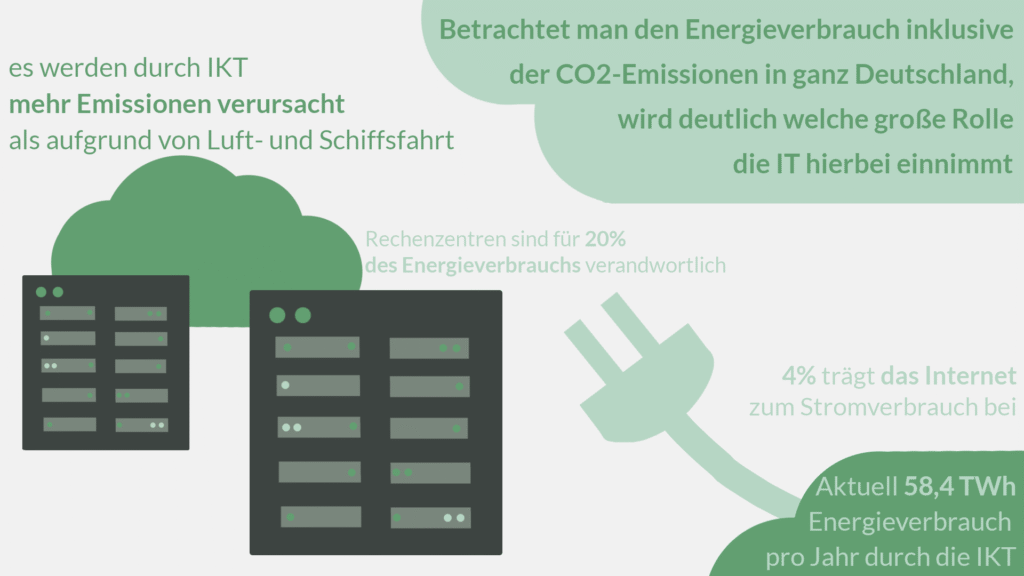
In Germany, the annual energy consumption of ICT is 58.4 terawatt hours, which corresponds to the annual electricity consumption of Switzerland.
The graphic further illustrates the energy consumption of IT infrastructures in Germany:
According to the non-profit organization The Shift Project, which takes action against climate change, it is estimated that CO2 emissions from the digital economy will account for approximately 8% of global CO2 consumption by 2025, which is more than all the cars and motorcycles in the world combined.
But how can IT technologies be designed more sustainably? This is where Green IT comes into play. What does Green IT actually mean?
2. Meaning of Green IT
Green IT refers to using information and communication technologies in a way that consumes as few resources as possible and protects the environment. This includes the resource-efficient development, use, and disposal of IT devices.
A distinction can be made between “Green by IT” and “Green in IT.” “Green by IT” means saving energy through the use of IT resources, such as switching from letters to email or from air travel to video conferences. “Green in IT” refers to saving energy within IT infrastructures or data centers.

3. What can companies do?
A study shows that currently only 6 percent of companies
comprehensively implement sustainable IT.
For companies, integrating and implementing sustainable IT infrastructures represents a major challenge. However, there are already numerous solutions for an environmentally friendly IT infrastructure in the company. Below, we present some solutions on how you too can make your company more sustainable.
Read the full article at your leisure or jump directly to a category:
Try leitzcloud now
See for yourself!
Create a trial account easily!
No payment information required.
Sustainable Procurement
The mention of the following seals is based on our editorial team’s own experience and research. We are not affiliated with the mentioned environmental seals.
When purchasing devices, companies can specifically ensure that they do not have harmful effects. This can be difficult for individuals, but attention can be paid to specific seals such as “Blue Angel,” “EU Ecolabel,” or the “Energy Star” seal of approval.
Paperless Office
A first step toward acting more sustainably in the company is to introduce a “paperless office.” As the term suggests, the goal is to save paper and switch to digital processes instead.
Shutting Down Devices
Many are familiar with it: the laptop is just closed and not properly shut down, which makes a significant difference in consumption compared to turning it off properly after work. The same applies to turning off lights and heating in the office overnight. These things should not be underestimated, as small changes can achieve a lot.
Raising Employee Awareness
To implement sustainability in the company, it is important that managers inform and educate their employees about it. Additionally, it is crucial that sustainability is lived convincingly by example. Only if it is consistently implemented by employees can an impact be made.
But how can companies proceed? The corporate vision and strategy should be clearly defined and known to every employee. Likewise, CO2 emissions in the company can be measured to subsequently define clear climate goals. It is important that these are regularly reviewed and adjusted. Through regular meetings, employees can contribute their own ideas to act even more sustainably in other areas. Training sessions could also be helpful to sensitize employees to the topic of sustainability.
Centralizing Devices
How many devices does the company really need? It is not necessary for every employee to receive their own complete set of equipment. Devices such as printers and scanners can be shared, which demonstrates significantly higher efficiency.

Cool the server room and adjust the lighting
50% of energy consumption is due to cooling and lighting. It is important to consider a few things here, such as appropriate insulation, avoiding direct sunlight, and optimal air conditioning. Switching to free cooling helps to save energy here.
A distinction is made between direct and indirect free cooling. With direct free cooling, filtered cold air from outside is transported into the data center. This is a cost-effective and energy-saving method. However, direct cooling depends heavily on the weather and local environment. For example, on a busy road with poor air quality, it is important to clean the filters frequently.
With indirect cooling, the air is directed into the data center via an air-to-water heat exchanger. This means that a cooling medium is cooled by the outside air and transported into the data center. In this case, dirt particles in the air do not pose a problem, but this method is not quite as efficient as direct free cooling because a heat exchanger is required.
Hardware Disposal
Ensure that hardware is disposed of properly so that parts of it can be recycled and reused.
Reusing Devices
Companies can avoid procurement costs, resources, and electronic waste by opting for the second-hand use of devices. There are now companies that professionally refurbish devices for reuse. This is particularly interesting for smaller companies that do not necessarily require the latest hardware.
Automated Processes
Processes such as backups can be automated, allowing a time window to be selected when less system performance is required.
Cloud Solution
It is much more resource-efficient to store your data in a cloud—where data is stored in a certified data center with state-of-the-art security—than on internal company servers.
Test the GDPR-compliant leitzcloud now, where your data is stored with 100% security in a sustainable, TÜV-tested data center.

Test leitzcloud now for 14 days with everything included for free!
We are not only responsible for what we do, but also for what we do not do.
Molière
Sources:
Sustainable IT (Accessed 2022-03-24)
Green IT – For the sake of the environment (Accessed 2022-03-24)
Digital Change and Climate Protection (Accessed 2022-03-24)
Green IT: Challenges, Goals, and Solutions for Sustainability in and through Information Technology (Accessed 2022-03-24)
6 Reasons Why Start-ups Should Rely on Sustainable IT (Accessed 2022-03-24)
Green IT: Tips for More Energy Efficiency in Companies (Accessed 2022-03-24)
Green IT: “Lean ICT” – Towards Digital Sobriety (Accessed 2022-03-24)
Green IT: Implementing Sustainability in the Company (Accessed 2022-04-04)
Free Cooling in the Data Center: Hype or Indispensable? (Accessed 2022-04-04)