

What is the difference between VPN and proxy?
Have you ever seen a message on YouTube or Netflix that this video is not available in your country? Or have you ever wondered how anonymous your internet activities actually are? A VPN or proxy offers a simple answer to this. Both hide your actual location, making it appear as if you are using the internet from a different location than where you actually are. How exactly does it work and what options do you have?
What is a VPN or a proxy?
To better understand VPN or proxy, it is helpful to get a general picture of how the internet works in general. To display a website on your computer, you simultaneously send a series of requests through the internet by, for example, entering “google.com” or clicking on a link. Such a request consists of several steps and uses different types of devices. Through the router at your home or office, your web request reaches the server where the website is stored. In addition to your web request, you also send information such as your computer’s IP address and your location so that the web server knows where to send the requested content. If you do not want the web server to know that you sent the request, but still want the webpage to be displayed, you can use a VPN or proxy server. Both act as an intermediate station to ensure that the request cannot be traced back to you. This makes browsing the internet much more anonymous and gives you more privacy.
Interested?
Find even more tips and information on data protection
and the workplace on our social media pages!
How does a VPN work?
VPN stands for Virtual Private Network. It creates an encrypted tunnel for all internet traffic from your computer. This means that all internet requests you make through this tunnel are sent to the VPN server. Your encrypted internet traffic then appears as a collection of unreadable characters. Only your computer and the VPN server can decrypt the code, which is unreadable to others.
How does a proxy work?
A proxy is like a VPN—an intermediate station between the user and the internet to make your location appear different. You again send a request for a website to the proxy server, which forwards it to the web server. When the web server tries to trace your request, it can only go back to the proxy server. The difference from a VPN is that a proxy is simpler and less secure. You must install a proxy for each application (web browser, email, calendar, etc.), while a VPN anonymizes all internet traffic. Furthermore, a proxy only hides your IP address by replacing it with the proxy’s IP address. Proxies are not encrypted, which is why your anonymity is not always guaranteed. Your internet service provider or someone monitoring the WiFi network in public transportation can still see or intercept your internet traffic. The advantage of a proxy is that it is not as demanding on your computer as a VPN and therefore does not slow down the internet. A VPN can significantly impact your internet speed because it must encrypt and decrypt every request. A proxy can easily be used for simple, less privacy-focused tasks. For secure internet use, it is important to use a reliable proxy. Unreliable proxies can sell your data or inject viruses.
Differences between VPN and proxy
A proxy and a VPN are very similar, but there are clear differences. We have therefore briefly summarized the most important differences for you.
VPN
An encrypted tunnel for your internet traffic that makes it appear as if the VPN server is making the request. Secures all your internet traffic from your computer.
Higher privacy, but may slightly reduce internet speed.
Proxy
Only hides your IP address—internet traffic may still be visible to the internet service provider or hackers. Installed per application (web browser, online game).
Little difference in internet speed if it is a good proxy.
Alternative to VPN and proxy—leitzcloud
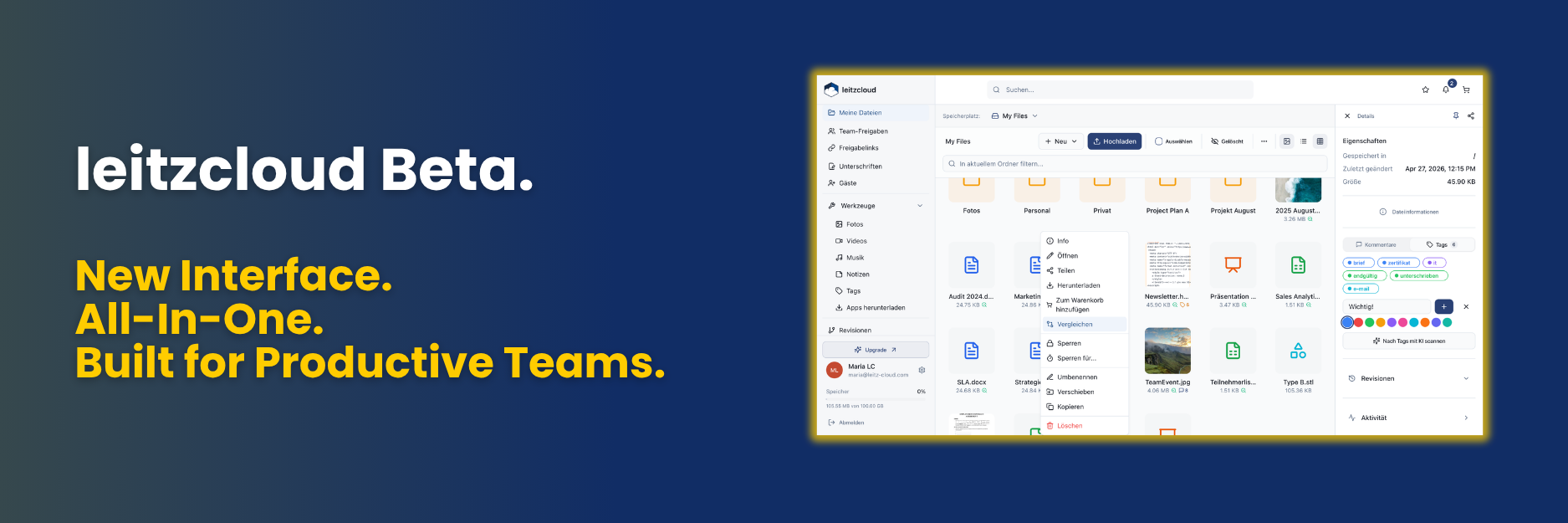
With leitzcloud, you do not need a VPN or proxy to access your files from a different location. You can open and edit your files from any location and on any device through fast synchronization. Furthermore, your files are stored in highly secure data centers with ISO 27001 certification. We also operate in full compliance with GDPR data protection regulations. The security of your data is our highest priority.