

What is Blockchain?
Blockchain is, as the name suggests, a chain of blocks that store information. Once information is included in a block, it is nearly impossible to change it again. When a user creates a block, a copy of the block is distributed across the computers of thousands of users.
The so-called miners operate in a peer-to-peer (P2P) network, where the consistent consensus is checked and verified before it is updated. If everything matches, the new information block is added to the database, creating an orderly chain of blocks. This decentralized distribution may sound unusual at first, but it ensures the security of a blockchain. Cryptographic methods are used for protection, allowing data sets to be encoded.
How is a Blockchain Structured?
A single block consists of three parts:
1. Hash:
Comparable to a fingerprint, as it uniquely identifies a block and its contents.
The hash is calculated as soon as a block is created.
2. Hash of the previous block:
A block always contains the hash of the previous block to ensure that the data is unchanged and consistent, creating a secure chain. If a block is modified, the subsequent blocks are declared invalid because the hash no longer matches.
3. Data:
This can be, for example, information about a transaction, such as the sender, recipient, and amount.
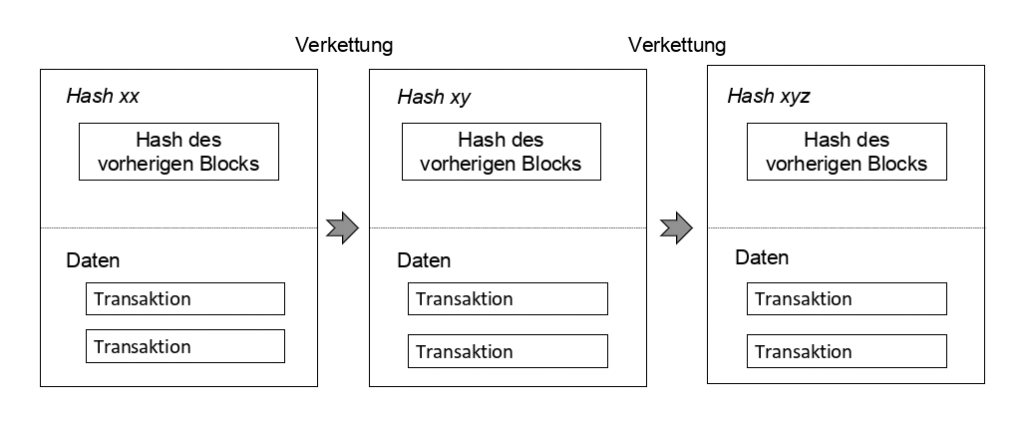
The linking of hashes creates a secure chain within the blockchain.
Why is a Blockchain Considered Particularly Secure?
The blockchain pursues certain protection goals that focus on security. Data stored in the blockchain is secured by the chaining of hash functions, so that data cannot be manipulated secretly. Targeted attacks on central points are therefore almost impossible.
In principle, the longer the blockchain, the more securely it is protected against failures and attacks. If analysis allows conclusions to be drawn about real persons, it is at most a matter of pseudonymity, as users are only visible via keys. Communication partners are authenticated regarding their identity within the network to ensure that they are indeed the person specified.
What is the Connection to Bitcoin?
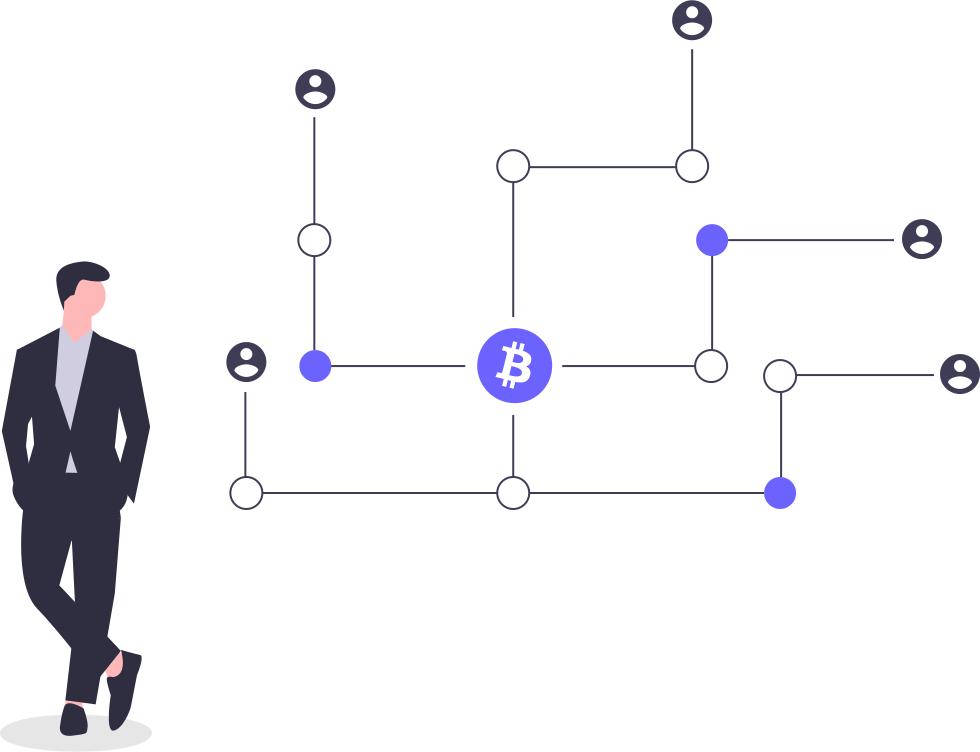
The concept of the blockchain forms the basis of the cryptocurrency Bitcoin, a decentralized and cryptographically secured payment system. The database consists of ordered and unchangeable entries and resembles a public register.
These register entries represent transactions in which Bitcoin values can be transferred from one address to another, similar to an account number. Users can see all transactions of the account holder but cannot assign the account to a real person. This transparency has the advantage that fraudsters can be quickly identified and excluded from the network. To manage Bitcoins, the user needs a Bitcoin wallet. These can be purchased on the internet, exchanged, or distributed as a reward to users who provide blocks.
The cryptocurrency Bitcoin is now accepted as a recognized means of payment by many companies.
What are the Advantages and Disadvantages of Blockchain Technology?
| Advantages | Disadvantages |
| High security | High computational effort |
| Transaction speed | High energy consumption |
| Ordered, transparent, and consistent documentation of every transaction | High transparency to third parties |
| Traceability of processes (authentication, fraud detection, etc.) | Residual risk of manipulation (51% attack)* |
| Data modification is nearly impossible | Data in public blockchains is not deleted, so it could involve data that was misused in the past. |
*51% Attack: This is a network attack where the attacker needs the absolute majority to change block information. However, this probability is very low, as the effort is associated with high energy costs and the attacks do not go unnoticed.
Conclusion
The topic of “blockchain” is, of course, much more complex and extensive, but its strength lies in the decentralized structure, which enables secure data exchange. Furthermore, high security against subsequent changes is offered through consensus algorithms. This new technology is still in its early stages but is frequently referred to in the digital economy as one of the next major innovations.
For many companies, it is an exciting topic as it offers new business models. Technical development is advancing particularly in the economic sector, but blockchain is also already being used in logistics, retail, and the healthcare sector. For example, product transport can be tracked and better controlled, and sensitive data can be managed securely.
Berlin has developed into one of the world’s leading centers for blockchain startups.
Try leitzcloud now for 14 days for free!
Sources:
How does the blockchain work – simply explained (2017):
YouTube (Accessed 2021-04-23)
Fill, Hans-Georg, Meier, Andreas (2020): Blockchain kompakt:
Springer Verlag (Accessed 2021-04-26)
Liu, Shanhong (2019): Advantages of blockchain technology worldwide:
Statista (Accessed 2021-04-29)
Schönbohm, Arne (2019): Designing blockchain securely:
Federal Office for Information Security (Accessed 2021-05-03)